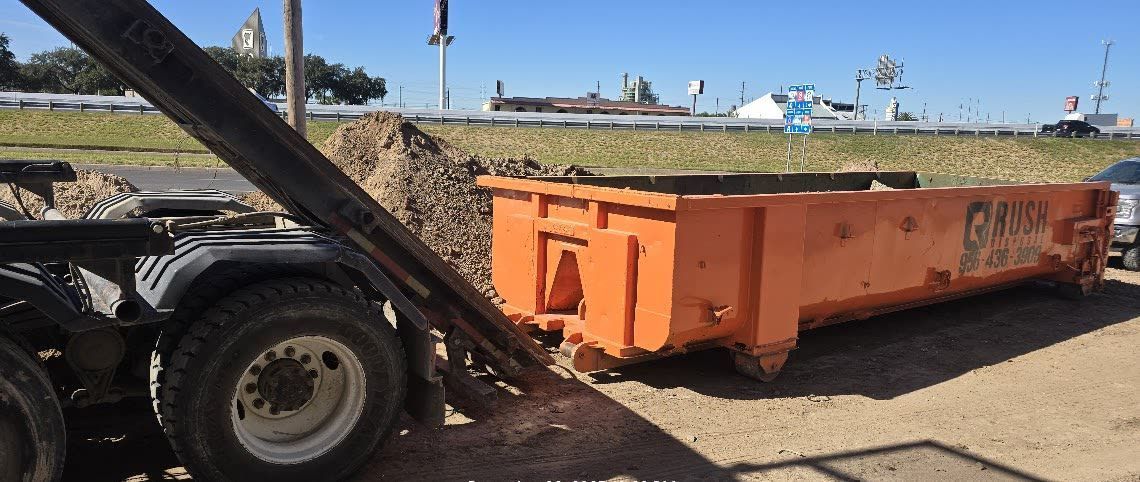
"What can you put in a construction dumpster?" came up in Google searches from towns all over our area, from Zapata and Hebbronville to Crystal City and Cotulla. It makes sense. A job site makes a lot of debris, and nobody wants a load turned away.
Here's what goes in a construction roll-off, what doesn't, and how residential and commercial jobs compare.
What goes in a construction dumpster
A construction roll-off is made for regular building and remodel debris:
- Lumber and scrap wood: framing, forms, pallets, trim
- Drywall and plaster
- Flooring: tile, laminate, carpet and pad, wood flooring
- Cabinets, countertops and fixtures
- Doors, windows and siding
- Roofing: shingles and tear-off debris
- Concrete, brick and block. Heavy, so watch the weight at $52 per ton, and call us to talk through the right size.
- Packaging: boxes, plastic wrap, foam
- Tires are accepted for an extra charge of $10 each, and
mattresses go in at no extra charge
What stays out of a construction dumpster
Rush Disposal does not accept hazardous or regulated materials. On job sites, the usual problem items are:
- Paint thinners, solvents, adhesives and other chemicals
- Fuel cans and pressurized cylinders
- Used oil and lead-acid batteries
- Asbestos-containing materials (old tile, insulation, siding or roofing you suspect contains it)
- Drilling mud and other regulated oil field waste
If you're doing demo on an older building, check the asbestos rules first. The Texas Department of State Health Services handles asbestos notifications. A single private home is generally exempt from federal notice requirements, but commercial and public buildings usually aren't. Check with DSHS for your project.
Residential vs. commercial dumpster: what's the difference?
People also search "what can you put in a residential vs. commercial dumpster." The short answer: with a Rush roll-off, the container and the rules are the same. What changes is the job.
Residential jobs are things like:
- A garage, attic or whole-house cleanout
- A bathroom or kitchen remodel
- A roof replacement on your home
- Yard cleanup after a storm
These often fit a 10, 15 or 20 yard.
Commercial jobs are things like:
- Tenant build-outs and office cleanouts
- Store and restaurant remodels
- New construction and large demolition
- Commercial roof tear-offs
These usually call for a 20, 30 or 40 yard.
Either way, the same items are allowed and the same hazardous items stay out.
What about a "Waste Management" or trash dumpster?
A trash dumpster behind a business, from the city or a hauler like Waste Management, is a different thing. Those are for regular bagged trash on a pickup schedule. A roll-off is for a one-time project: you load it, we haul it. If you have remodel or construction debris, don't stuff it in your regular trash bin. Get a roll-off.
In Laredo, Rush Disposal is signed up under the City of Laredo's franchise agreement. We're one of only about 20 franchised haulers in the city.
Picking a construction dumpster size
- 10 yard — Price: $150; Included time: 48 hours; Good for: Small remodels, minor demo
- 15 yard — Price: $225; Included time: Up to 7 days; Good for: Drywall, flooring, cabinets
- 20 yard — Price: $250; Included time: Up to 14 days; Good for: Home renovations, roofing, small commercial
- 30 yard — Price: $300; Included time: Up to 14 days; Good for: Construction sites, concrete, lumber
- 40 yard — Price: $400; Included time: Up to 14 days; Good for: Major construction, large demolition
Every size includes delivery and pickup. Extra days are $10 each. Weight is $52 per ton, and no tons are included.
Job site tips
- Keep the container close to the work. Fewer steps, faster loading.
- Load heavy debris low and spread it out.
- Separate anything questionable and call us before tossing it.
- Plan for weight. Concrete and tile weigh far more than lumber.
- Call us when it's full. We're open 7 days a week, 24 hours a day.
FAQ
What can you put in a construction dumpster? Lumber, drywall, flooring, cabinets, roofing, siding, concrete, brick and packaging from regular construction and remodel work.
What can't go in a construction dumpster? Hazardous or regulated materials, like chemicals, fuels, used oil, batteries, asbestos and drilling mud.
What can you put in a commercial dumpster vs. a residential one? With a Rush roll-off, the same rules apply. Only the job size changes.
Can I mix household junk with construction debris? Yes, as long as nothing hazardous goes in.
Get a construction roll-off
Book online at
booking.rushdisposal.com or call
(956) 436-3909. Open 7 days a week, 24 hours a day. Same-day delivery is often available. See the
30 yard and
40 yard pages, or check our
service area.
Sources
- TCEQ, "Household Hazardous Waste: A Guide for Texans": https://www.tceq.texas.gov/p2/hhw
- Texas DSHS, asbestos abatement and demolition notification FAQs: https://www.dshs.texas.gov/asbestos-program/frequently-asked-questions-faqs/frequently-asked-questions-about-asbestos-abatement-demolition-notifications
- US EPA, "Sustainable Management of Construction and Demolition Materials": https://www.epa.gov/smm/sustainable-management-construction-and-demolition-materials
- Rush Disposal size pages (uses and prices): https://www.rushdisposal.com/20-yard-dumpster-rental-laredo, https://www.rushdisposal.com/30-yard-dumpster-rental-laredo, https://www.rushdisposal.com/40-yard-dumpster-rental-laredo